Whitsundays Stinger Season: Dates, Nets And Stinger Suits
Marine stingers can be present in Whitsundays water all year, and the higher-risk window runs November to May. Here is what that means for the tours you book, the suits you wear and where you swim.
Short answer
Whitsundays stinger season runs November to May, though marine stingers can be present all year. Full-length lycra stinger suits are provided free on commercial tour boats and at island resorts in the season, the Airlie Beach Lagoon is a free, patrolled, stinger-free swimming option, and first aid for a sting is vinegar and calling 000.
Marine stingers are the question every swimmer eventually asks about North Queensland water, and the honest answer has two parts. Box jellyfish and Irukandji can be present in Whitsundays water in any month of the year, and the officially recognised higher-risk season, the window Queensland authorities and local operators all plan around, runs November to May. Neither part of that sentence means the water is off limits, and tens of thousands of people snorkel the Whitsundays every summer without incident, but both parts should shape what you book and what you wear. The Red Cat catamaran, the Ocean Rafting speedboat, the Cruise Whitsundays half day and the Reefworld pontoon all run straight through the season, and every one of them manages stinger risk with suits and crew briefings rather than by staying ashore.
This guide lays out the dates, the suit policies operators actually publish, the nets and the lagoon in Airlie Beach, and the first aid steps Queensland Health wants everyone to know. The short version for a reader deciding whether to book a snorkel trip: yes, book it, wear the suit the crew hands you, and save your unclothed swim for the lagoon.
When Is Stinger Season In The Whitsundays?
The higher-risk marine stinger season in the Whitsundays runs November to May, and Queensland Government advice is blunt that stingers can be present in tropical water all year, so no month is stinger-free. The same window overlaps the official Australian cyclone season, which the Bureau of Meteorology sets from 1 November to 30 April, meaning summer trips carry two weather considerations at once.
The Queensland Government's dangerous marine creatures page states that marine stingers may be present year-round in tropical Queensland, with risk elevated during the marine stinger season from November to May. Surf Life Saving Queensland publishes the same window, and Tourism Whitsundays, the region's official tourism body, repeats it. The practical reading is seasonal, not binary: risk is lowest in the dry winter months, rises through spring and peaks across the wet season. No month-by-month sting calendar is published for the Whitsundays, so treat the risk as live across the whole season rather than concentrated in a few peak weeks.
Two other seasonal facts sit alongside the stinger window. Water temperature in the Whitsundays ranges from about 22 degrees in winter to about 29 degrees in summer per Tourism Whitsundays, which is why a lycra suit doubles as welcome warmth on winter snorkels for some people. And the cyclone season, 1 November to 30 April per the Bureau of Meteorology, means summer bookings deserve a cancellation policy you have actually read. Most listings on this site show free cancellation on the booking page, including the featured Red Cat Whitehaven snorkel cruise, but confirm the terms before you pay rather than after.
| Period | Stinger risk | What it means for swimmers |
|---|---|---|
| November to May | Higher risk, official season | Full stinger suit advised on every swim outside netted or pool water |
| June to October | Lower risk, stingers still possible year-round | Suits optional on many trips, still supplied by many operators |
| 1 November to 30 April | Official cyclone season (BoM) | Check forecasts and cancellation terms when booking |
There is a planning nuance worth naming. Winter, June to August, is peak season in the Whitsundays for good reasons: dry days, mild nights and humpback whales. September and October sit in the shoulder, dry and calm, but October already brushes the start of the higher-risk stinger window in late-month weeks as Tourism Whitsundays notes when planning around October travel. A September sail and a January sail are different products in every sense, and stingers are only one of the differences.
Do You Need A Stinger Suit On Whitehaven Beach Tours?
Yes, from November to May a full-length lycra stinger suit is advised for any swim or snorkel outside netted water, and the good news is you rarely need to bring one: Tourism Whitsundays states suits are provided free on all commercial tour boats and at island resorts during the season, with most operators supplying or hiring them. On Whitehaven Beach itself there is no public stinger net, so the operator-supplied suit is the protection that matters.
The suit itself is simple: a full-body lycra layer that covers roughly 90 percent of the skin, which is why operators describe it as the single effective precaution. Red Cat Adventures states suits are provided at no additional cost on all its boat tours and that it recommends and provides suits year-round, since jellyfish can be present on any given day. Ocean Rafting, whose speedboat day trips carry the most reviews of any operator on this site at 4.9 from 5,008 reviews on one listing, highly recommends hiring a suit in the season and arranges hire at check-in. Its listings exclude pregnant guests and people with back problems, a standing condition of the speedboat format worth knowing before you book that style of trip.
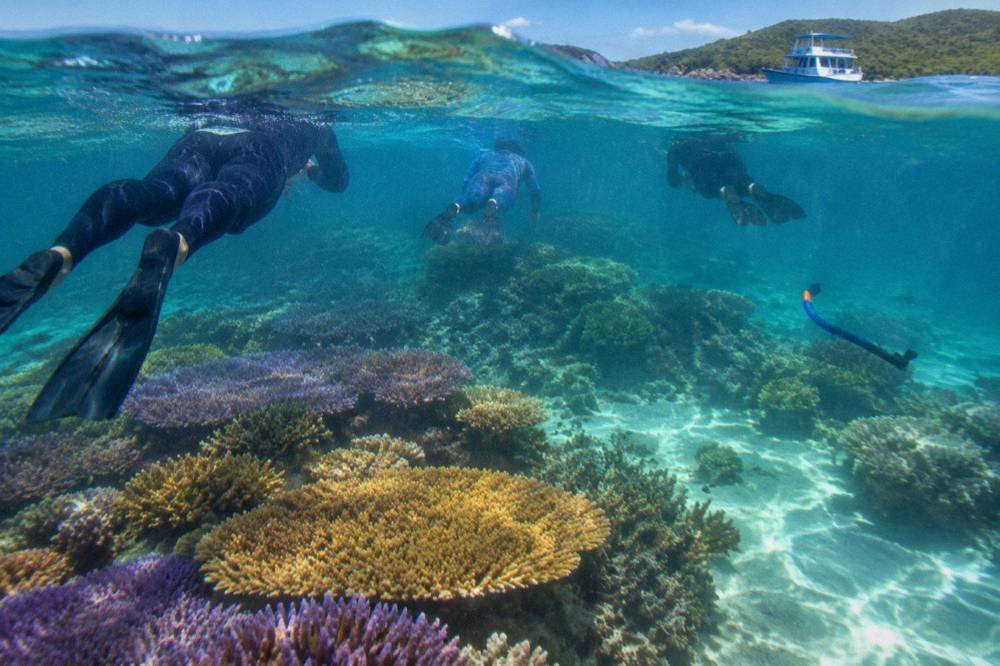
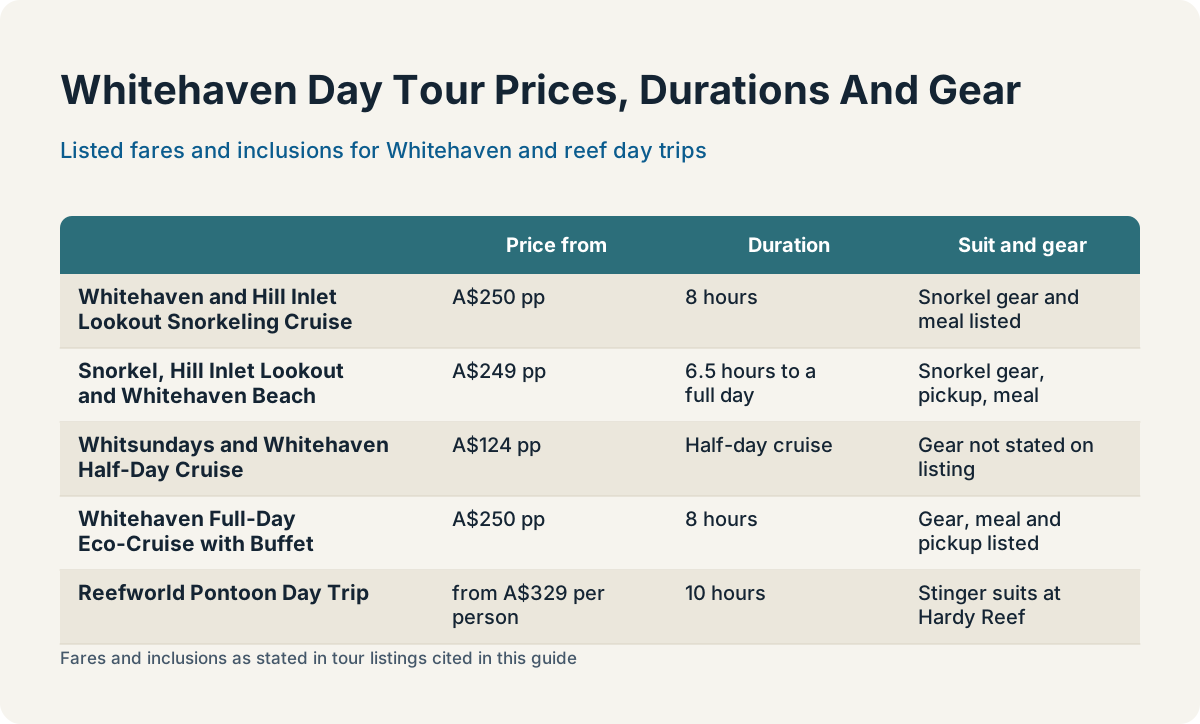
What this means for choosing a tour is that the decision is mostly about format and price, not safety, because the suit policy is close to universal on commercial boats. The roster below shows how the main Whitehaven day trips handle the stinger question, using only what each listing states.
| Tour | Operator and format | Price from | Suit and gear stated |
|---|---|---|---|
| Whitehaven and Hill Inlet Lookout Snorkeling Cruise | Red Cat, high-speed catamaran, 8 hours | A$250 pp | Snorkel gear listed, free cancellation, meal listed |
| Snorkel, Hill Inlet Lookout and Whitehaven Beach | Ocean Rafting, speedboat small groups, 6.5 hours to a full day | A$249 pp | Snorkel gear listed, pickup listed, meal listed |
| Whitsundays and Whitehaven Half-Day Cruise | Cruise Whitsundays, half-day cruise from Port of Airlie | A$124 pp | Gear not stated on the listing, check the booking page |
| Whitehaven Full-Day Eco-Cruise with Buffet | Red Cat, catamaran, 8 hours | A$250 pp | Snorkel gear listed, meal and pickup listed |
The budget half-day fare deserves one honest note: its listing does not state snorkel gear or meal inclusions, and "not stated" is not the same as "not included", it means ask before you assume. At A$124 per person it is the cheapest Whitehaven day trip on this site and a reasonable pick for a traveller whose priority is the beach and the inlet views rather than a long snorkel. For a full comparison of every option, read the Whitehaven Beach tours from Airlie Beach guide.
One reef-specific point: the Environmental Management Charge, the Great Barrier Reef Marine Park charge collected by tour operators, is A$8.50 for a full-day passenger and A$4.25 for a part-day passenger, rising to A$9.00 and A$4.50 from 1 April 2027 per the Great Barrier Reef Marine Park Authority. No listing on this site states whether the charge is included in its fare, so treat it as a possible extra line on the booking page and check there.
Where Can You Swim Safely In Airlie Beach During Stinger Season?
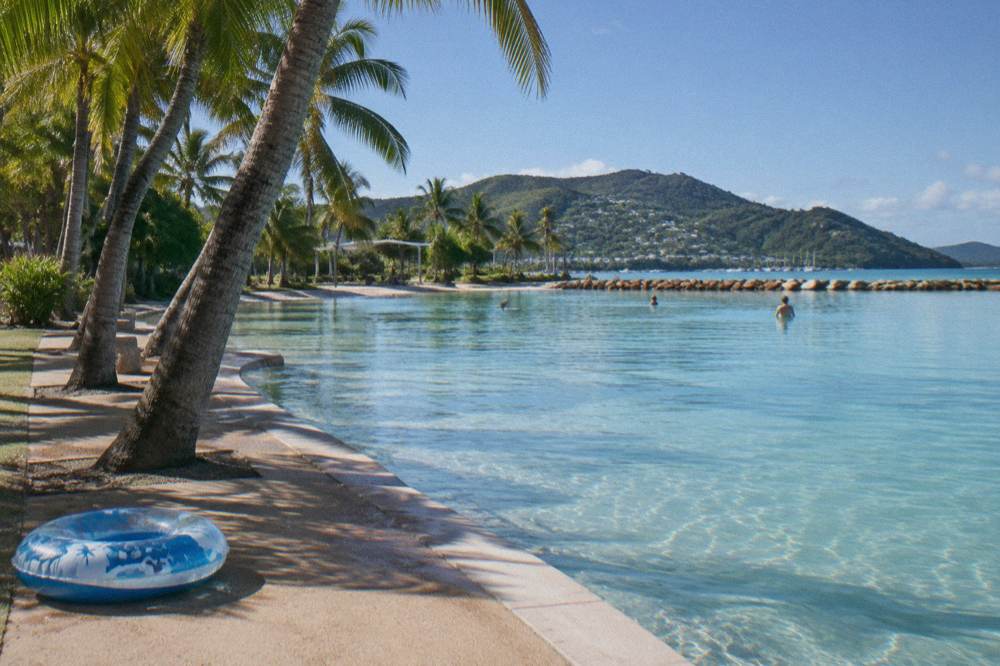
The Airlie Beach Lagoon is the town's stinger-free answer: a free, patrolled saltwater pool open year-round on the foreshore, where the stinger question does not apply. In the ocean, stinger nets are only in place at some beaches during the season, and Whitehaven Beach has no public net at all, so unprotected ocean swims in the season are not the local norm.
The lagoon is the single most useful fact for a nervous swimmer. Tourism Whitsundays describes it as stinger-free year-round, it is free to enter, and it is patrolled, which no island beach in the Whitsundays can claim. Queensland Parks states plainly that Whitehaven Beach and the islands are unpatrolled. For families travelling in January or February, the pattern that works locally is simple: lagoon for swimming, boats for the islands, suits for any water off a boat. The full picture is in the Airlie Beach Lagoon guide.
Nets are the second layer. Tourism Whitsundays notes that stinger nets are in place at some beaches during the season, typically November to May, with local references to Boathaven Beach at Port of Airlie and Cannonvale Beach. An important limit on what a net does: enclosures of this kind block larger box jellyfish but not Irukandji, which is exactly why official advice pairs nets with suits rather than replacing one with the other. Current installation status at any individual beach is not published week to week, so treat a net as a bonus, never as a substitute for a suit.
| Swimming option | Stinger protection | Patrolled | Cost |
|---|---|---|---|
| Airlie Beach Lagoon | Stinger-free by design | Yes | Free |
| Netted mainland beaches in season | Net enclosure, does not stop Irukandji | Varies | Free |
| Whitehaven Beach and island beaches | None, suit advised Nov to May | No | Free to swim |
| Commercial tour snorkel stops | Operator-supplied stinger suits | Crew supervision | Tour fare |
A third layer is timing and behaviour. Local advice is to swim in the middle of the day rather than dawn or dusk, to stay near other swimmers, and to keep children in suits even in shallow water, since stingers can drift close to shore. None of this is a guarantee, and Queensland advice never presents it as one. What it does is stack small margins, the same way a seatbelt stacks a margin inside a car rather than making driving safe.
What Happens If Someone Gets Stung In The Whitsundays?
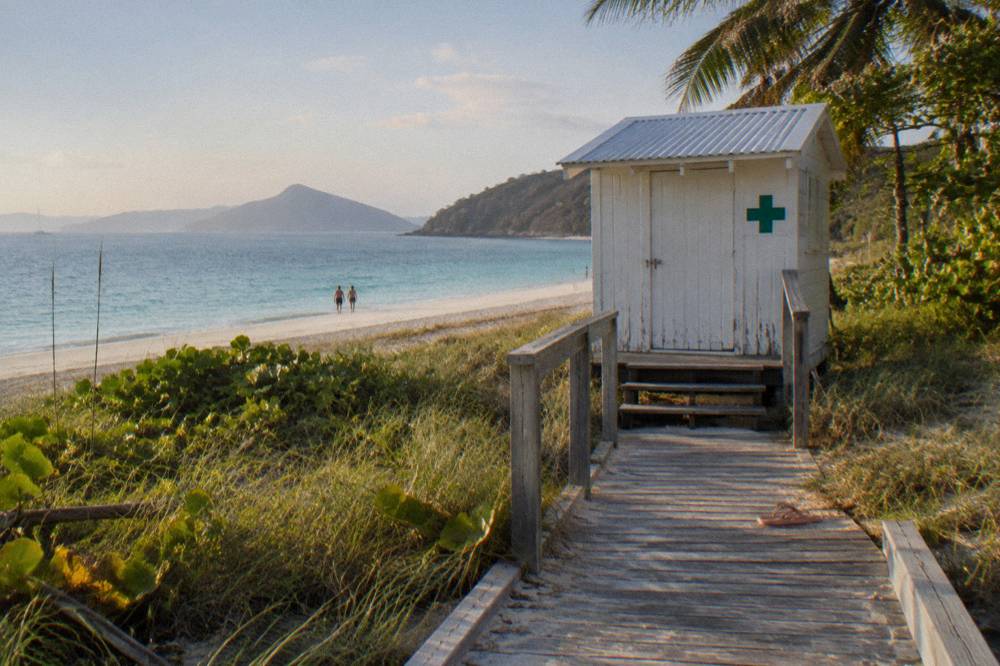
Queensland Government first aid for a marine sting is to flood the area with vinegar for at least 30 seconds, call 000 for an ambulance, and treat for shock, with cardiopulmonary resuscitation if the person is unresponsive. Commercial tour boats in the Whitsundays carry vinegar in their first aid kits and brief crews on sting response, which is a large part of why travelling on a licensed boat is safer than swimming alone from a beach.
The steps are worth memorising even if you never need them, because the wrong response makes things worse. Do not rub the sting, do not apply fresh water, and do not remove tentacles with bare hands. Vinegar neutralises undischarged stinging cells; fresh water can trigger them to fire. Queensland Health's advice line is 13 HEALTH for guidance when the situation is unclear, but any suspected Irukandji sting, whose symptoms can include severe back pain, cramps and anxiety delayed by up to an hour or more after the sting, is a 000 call, full stop. The full index of guides sits on Whitsunday Island Tours.
Context matters here so that fear is proportionate. Incidents are rare on commercial tours, where suits are the norm and crews are trained, and Any incident figure quoted in a forum thread is guesswork. Judge a tour by its stinger suit policy and crew briefing instead.. The risk profile that matters to a visitor is simple: unsuited, unaccompanied ocean swims in the season carry the avoidable risk; suited swims from tour boats carry very little. The Whitsundays snorkelling guide covers how operators manage reef stops in more detail.
| Step | Action | Why |
|---|---|---|
| 1 | Flood the sting with vinegar for 30 seconds or more | Neutralises undischarged stinging cells |
| 2 | Call 000 | Irukandji symptoms can be delayed and severe |
| 3 | Keep the person still, monitor breathing | Treat for shock |
| 4 | CPR if unresponsive | Standard emergency response |
| Never | Rub the area, use fresh water, touch tentacles bare-handed | All can trigger more stings |
One geographical note from Queensland Parks: the islands have no lifeguards and no mobile reception at Whitehaven Beach or Tongue Point, so an independent beach swim in the season is also a communications risk. Boats carry radios and trained crew. That asymmetry, not the stingers themselves, is the strongest argument for seeing the islands on a tour rather than alone.
Which Whitsundays Tours Run Through Stinger Season?
Every major tour category on this site runs through stinger season, from the Red Cat and Ocean Rafting Whitehaven day trips to the Cruise Whitsundays reef pontoon, the OzSail overnight sails and the Heart Reef scenic flights, with suits supplied on the boats and flights unaffected by marine conditions altogether. Stinger season removes almost nothing from the Whitsundays menu; it changes what you wear in the water.
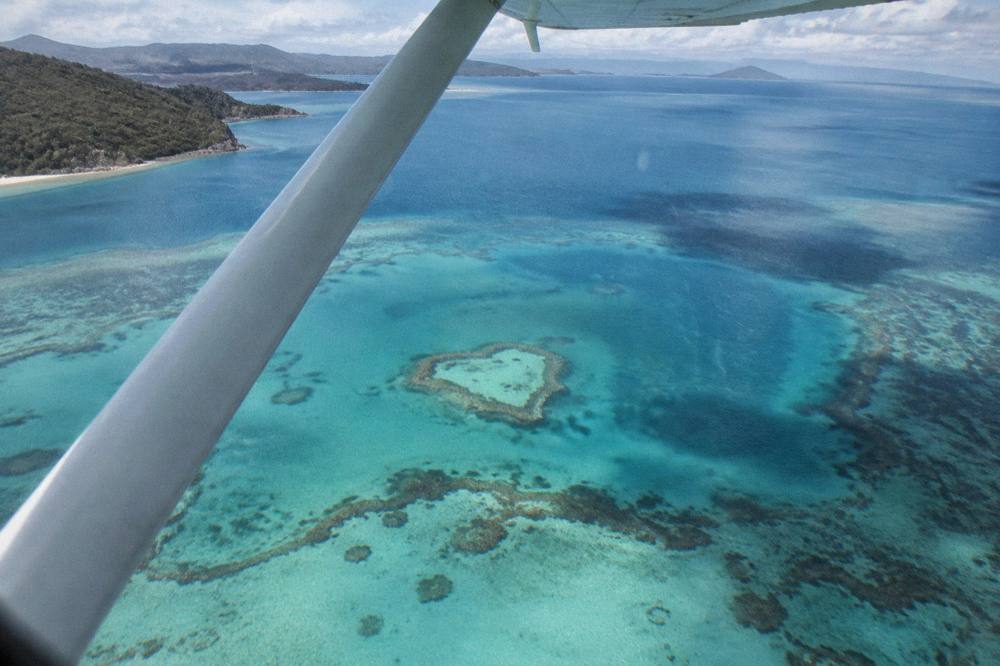
The reef products are the clearest example. The Cruise Whitsundays Reefworld pontoon day trip, from A$329 per person for 10 hours, lists snorkel gear, stinger suits at Hardy Reef per the operator, and a meal, and the same operator's reef day product on this site carries a 4.2 rating from 601 reviews. A scenic flight is the one Whitsundays experience that ignores the stinger question entirely: the Ocean Rafting Heart Reef flight, from A$355 per person for one hour, and the Whitsunday Air Tours 70-minute flight, from A$299 per person, both put the reef below you with nothing in the water at all. The Heart Reef scenic flights guide compares them in full.
Overnight sailing runs all year as well, with suits listed among the inclusions. The OzSail two-night sailing trip, from A$600 per person with meals and snorkel gear listed, and the Prosail two-day two-night maxi sailing adventure, from A$699 per person, both carry guests through the season, and the shorter Matador two-day one-night format, from A$495 per person, fills the same role in less time. Freshwater showers, enclosed cabins and wetsuit or suit hire for winter weeks round out a format that treats stingers as a packing detail. Summer is also the quietest time on the water, which many travellers count as a feature rather than a bug.
For travellers whose whole aim is a water day at the lowest price, the Cruise Whitsundays half-day Whitehaven cruise at from A$124 per person is the floor of the market on this site, and the Reefworld day trip covers the outer reef instead of the islands. Which of those two experiences you want, islands or outer reef, is a bigger question than stingers will ever be in either case.
Is Stinger Season A Bad Time To Visit The Whitsundays?
No, stinger season is not a bad time to visit the Whitsundays, and for some travellers it is the best time: summer brings the greenest islands, warm water around 29 degrees, afternoon storms rather than all-day rain, the lowest crowds of the year and lower shoulder pricing, while the suit requirement costs nothing on most boats and takes a minute to put on. The real trade-off is weather, cyclones and humidity, not stingers.
Tourism Whitsundays' own seasonal advice frames it that way: December to February delivers the hottest days and the greenest islands, March to May is the quietest period as humidity drops, and January and February rain typically arrives as afternoon build-up rather than continuous grey. The trade winds ease and the water is at its warmest. Set against that, the Bureau of Meteorology's cyclone season, 1 November to 30 April, is the reason to book refundable products in summer, and the stinger suit is simply part of the packing list, like a rash shirt anywhere in Queensland. For the full seasonal comparison including the winter whale months, see when to avoid the Whitsundays. If heat, stingers and the odd cyclone watch sound manageable but shoulder-season crowds appeal more, the month-by-month guide to the Whitsundays' hardest travel windows also pinpoints which sailing trips keep running well when the weather turns.
For a booking decision, the honest summary this site can stand behind runs to three lines. Wear the suit from November to May and anywhere a crew hands you one. Swim unsuited at the lagoon, not at an island beach. And pick your tour for its route, price and duration, because every licensed operator in the region, from the Red Cat catamaran to the OzSail overnight yachts, has already answered the stinger question for you.
Common Questions About Whitsundays Stinger Season
When is stinger season in the Whitsundays?
The higher-risk marine stinger season runs November to May. Stingers can be present in Whitsundays water all year, so no month is treated as stinger-free by Queensland authorities.
Do I need a stinger suit on a Whitehaven Beach tour?
From November to May a full-length lycra suit is advised for any swim or snorkel outside netted water. Tourism Whitsundays states suits are provided free on commercial tour boats in the season, and operators such as Red Cat Adventures provide them at no additional cost on all boat tours.
Can you swim at Whitehaven Beach without a stinger suit?
You can, in the sense that nothing physically stops you, but it is not advised from November to May and there is no stinger net on Whitehaven. The beach is unpatrolled with no mobile reception, so the local norm is a suited swim from a tour boat. More detail is in our can you swim at Whitehaven Beach coverage.
Is the Airlie Beach Lagoon really stinger-free?
Yes. Tourism Whitsundays describes the lagoon as stinger-free year-round. It is a free, patrolled public pool on the foreshore, and it is the town's standard answer to safe swimming in the season.
What is the first aid for a marine sting in the Whitsundays?
Flood the area with vinegar for at least 30 seconds, call 000, keep the person still and treat for shock, and start CPR if they are unresponsive. Do not rub the sting, use fresh water or touch tentacles with bare hands.
Do Whitsundays tours get cancelled for stingers?
No. Tour cancellations are driven by weather, wind and cyclone activity, not stingers. Boats supply suits and continue to run through the season; the cyclone season from 1 November to 30 April is the factor worth checking cancellation terms for.